Let’s talk about 1D cellular automata.
You start with a row of cells that are either black or white. Then, for each cell on the next row, you look at the state of the cells orthogonally or diagonally adjacent to and above it to determine the state of the new cell.
For example, here’s Rule 60, named after the sequence of resulting states (00111100) in binary.

And here’s what happens when you actually run Rule 60:
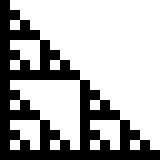
Before moving on, try to understand the way I’m generating this, if you don’t already. You’ll need it for the next part.
So, now, I was wondering: what would happen if you looked 2 rows above, not just one? Let’s say we’re using the three cells from before, as well as the cell two above it. And, for the sake of simplicity, let’s make the rule that the new cell is black when the number of black cells in said area above is odd.
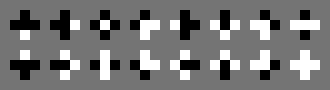
This new rule could also be formulated as “every cross shape must have an even number of black cells”.
So, let’s see what happens!
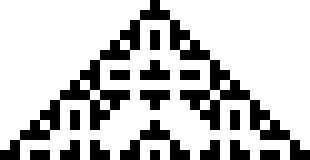
This is the first 16 rows. And so far, it looks a bit strange, but nothing in particular seems to jump out.
But if we continue it:
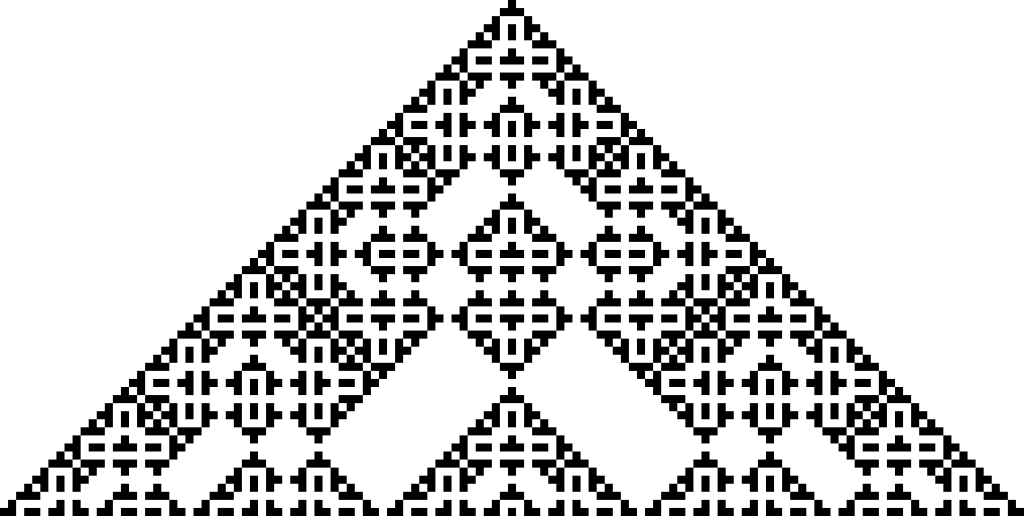
It seems to have some sort of larger grid system.
Maybe if we isolate the larger grid, something will happen.
Clean up the edges…
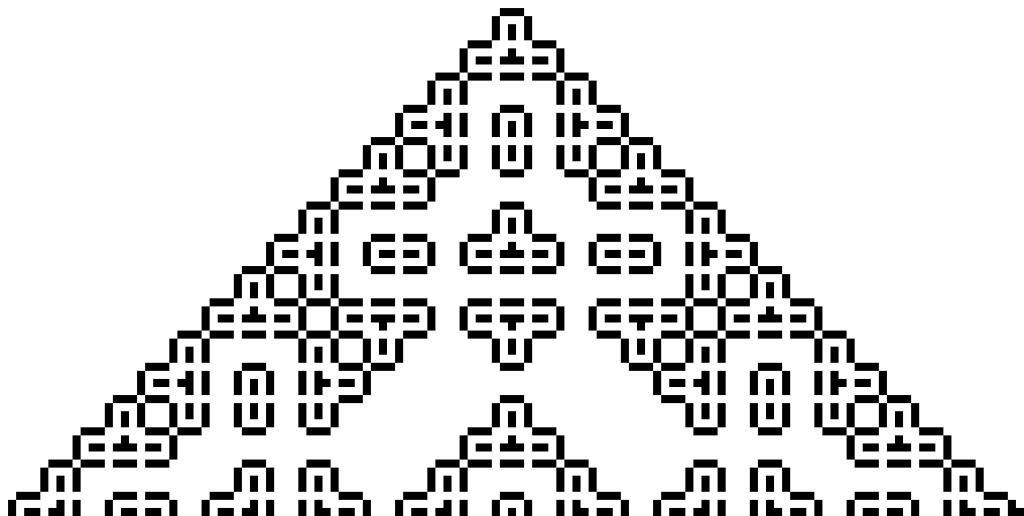
…connect the lines…
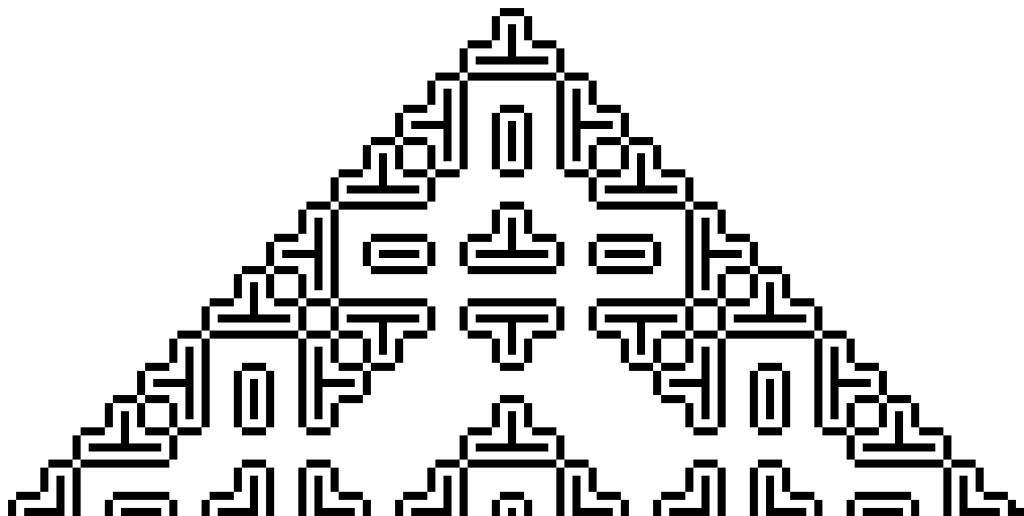
…straighten out the corners…
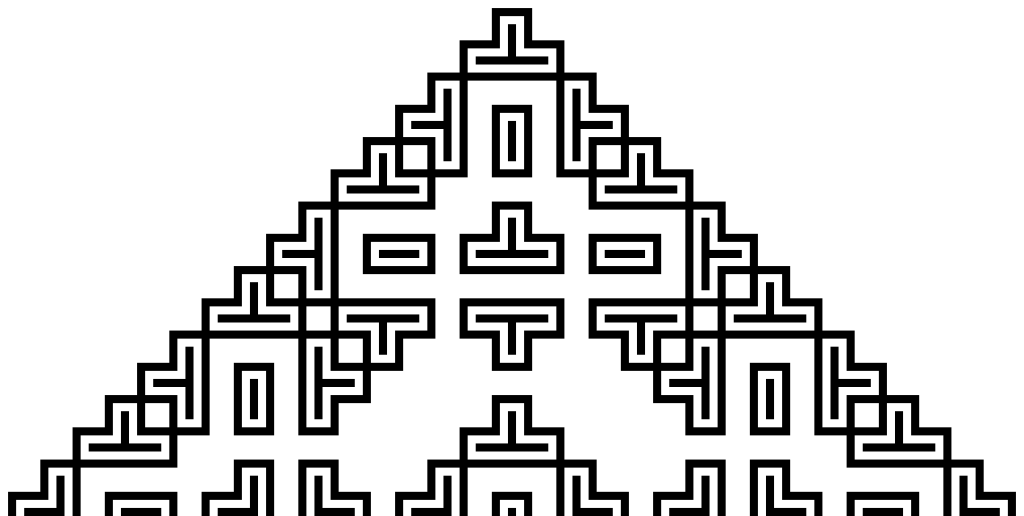
…and fill in the shapes.
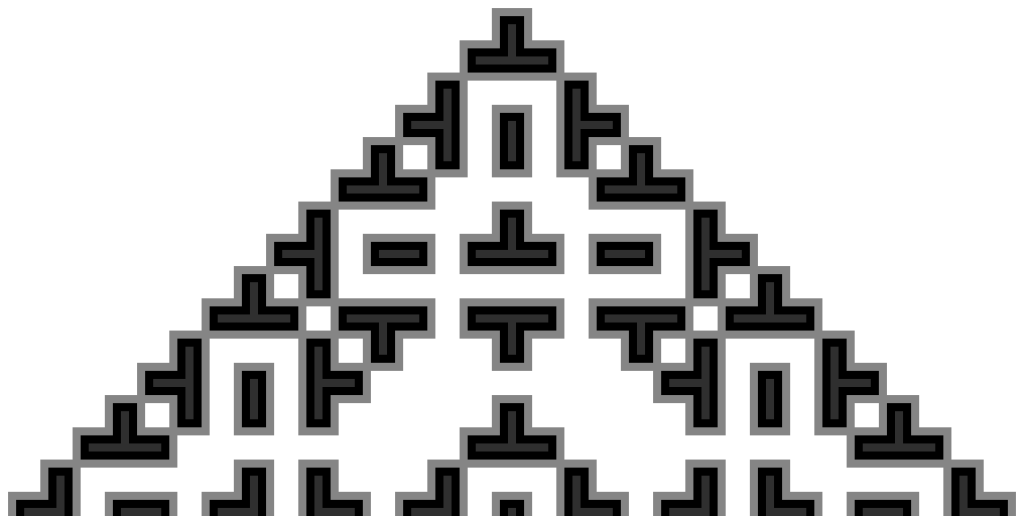
Does this look familiar, by any chance? Hint: scroll up.
Yep– it’s the same pattern!
My reaction when I figured that out was genuine disbelief. Like, “There’s no way.”
I still have no idea why that happens. I mean, even Rule 60 kind of had self-similarity, being the Sierpinski Triangle and all. But not like this, that’s for sure!


Leave a Reply